Distinguished Critique: The Demon: From the Darkness Review
Choppy plotting and poetry can't quite fully discredit an arc which takes an anti-hero into intriguingly darker contexts
—by Nathan on November 10, 2026—
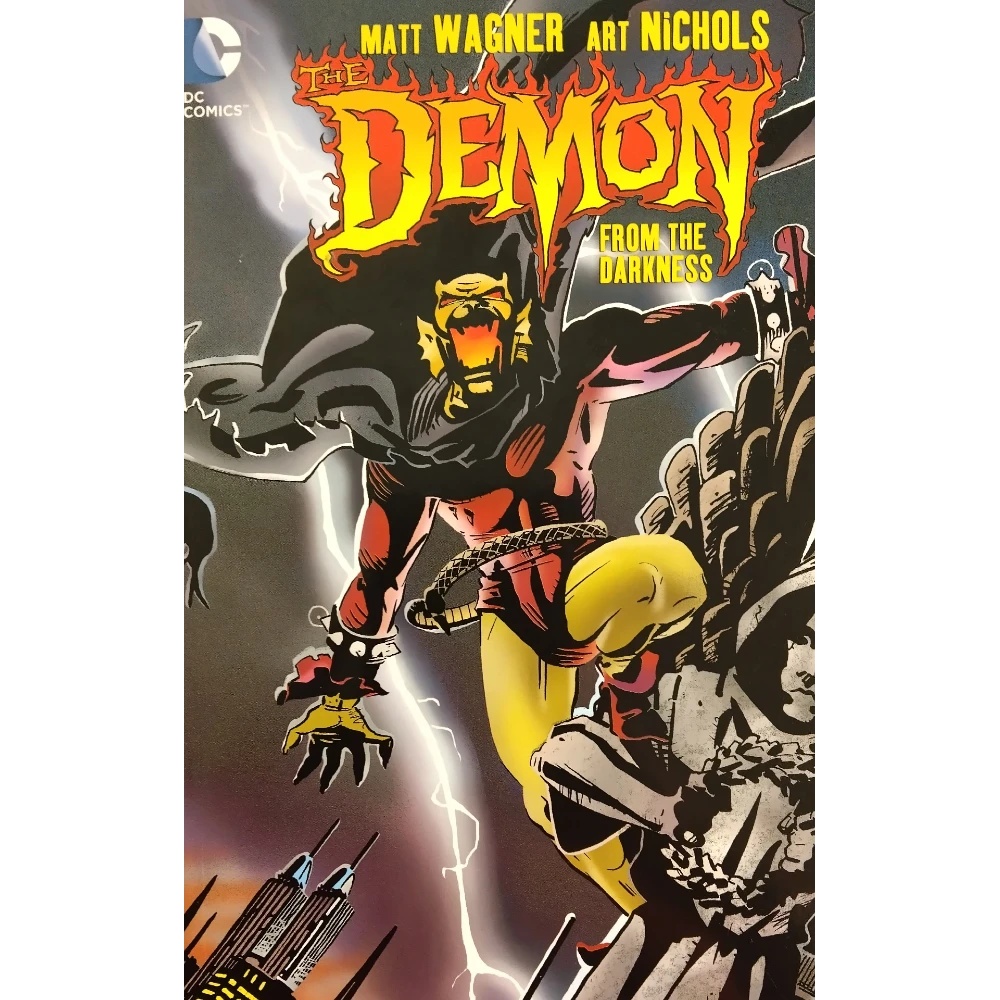
In a volume of Alan Moore's Swamp Thing I recently reviewed, good old not-actually-Alec-Holland-after-all found himself paired with some unsavory denizens of the deep and dark to keep an even more unsavory denizen from eradicating eternity. Phantoms, dead men, demons, those sorts of rabble. Folks who tend to trip across the border between the physical plane and the metaphysical and mess about in more ethereal matters.
Folks you may not always be able to count on as heroes.
Back in the 70s, during the same stint at DC which birthed Darkseid, the New Gods, and the Forever People, Jack Kirby invented Etrigan the Demon, as history tells, at the behest of DC higher-ups who wanted a more commercially successful series than Kirby's Fourth World mythology. As history tells also, The Demon was. Etrigan fared better than Kirby's cosmic creations, though he was eventually consigned to the flame pits of discontinuation. Between the cancellation of that series and this four-issue saga, Etrigan bopped along as a supporting cast member, traipsing through titles like his flitting fondness for forming rhymes (a trait not introduced until after Kirby's series, its use fluctuating depending on the writer), before landing in today's series.
Aside from a reference to an earlier team-up with Swampy during Moore's run, Matt Wagner's four-issue series is disconnected from the events of Moore's saga. Still, Etrigan's appearance during my latest dive into the Swamp saga amused me enough to consider his adventures here.
So in this four-issue stretch
Perhaps we can boast
Of a demonic wretch
And his human host
The Demon: From the Darkness
Writer: Matt Wagner
Penciler: Matt Wagner
Inkers: Art Nichols and Matt Wagner
Colorists: Adrienne Roy, Anthony Tollin, and Bernie Mireault
Letterers: John Costanza and Todd Klein
Issues: The Demon (vol. 2) #1-4 and The Demon (vol. 3) #22
Publication Dates: January 1987-April 1987, April 1992
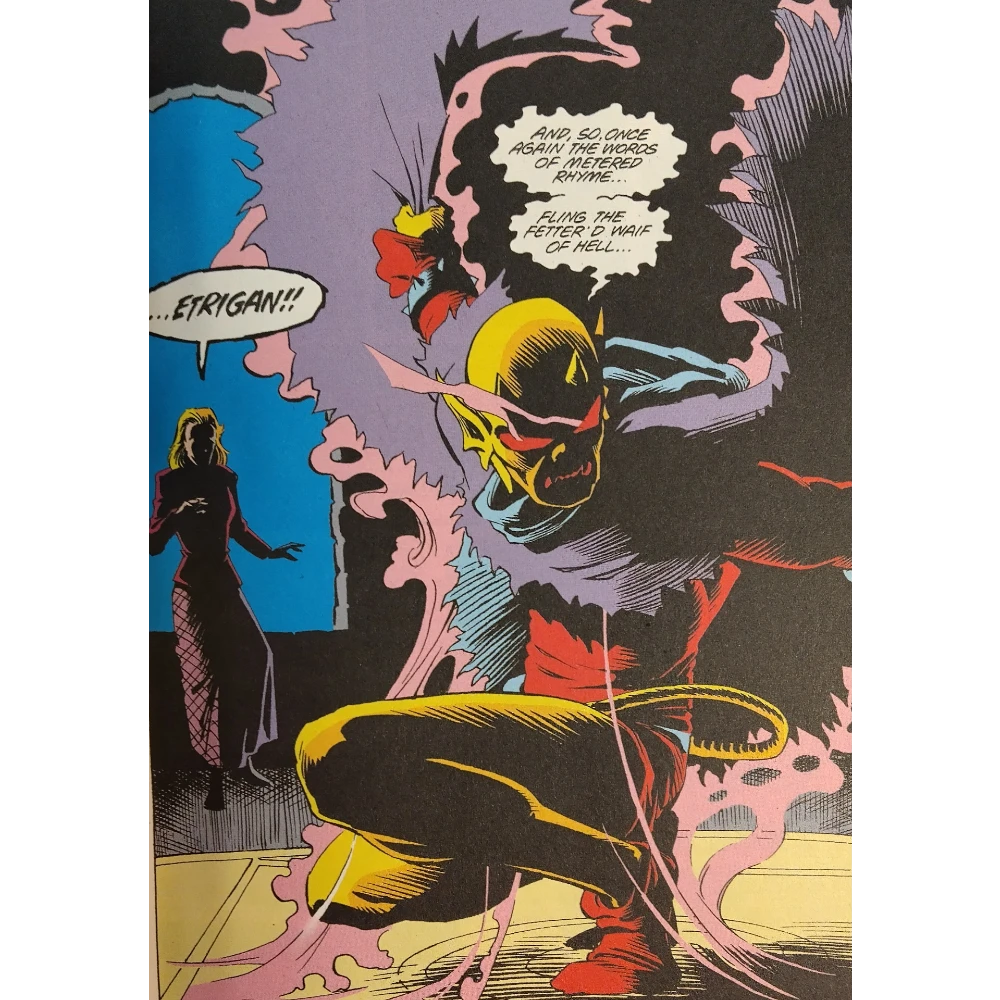
Though I own the collected edition of Kirby's original Demon series, I have not yet perused its pages to comprehend Etrigan's original narratives. Thus, regrettably, I am ignorant of some context which may have made entering this series a somewhat easier task. Wagner does tell his own tale, but it is beneficial to understand some of Kirby's 1970s material. In my mind, I just told myself this was like reading Mark Evanier's New Gods series before delving into the roots of Kirby's original New Genesis/Apokolips conflict, that I would be provided the necessary context and needn't worry about extraneous information.
Fortunately, Wagner's series serves itself well as a standalone offering.
The basic plot can be a little thin, Wagner tethering his series' inciting incident to a pretty vague, somewhat uninteresting coincidence, utilizing that to propel the plot's central question which Etrigan's host Jason Blood and his (seemingly former) love interest Glenda seek to answer. The answers wind up, by time the series ends, to be more interesting than I initially assumed they'd be, but I was sort of on disgruntled Jason's side initially. Spurning Glenda at first, Mr. Blood, and his horrific other half, are drawn into the mystery, taking them on a journey which becomes more compelling than taken at first blush.
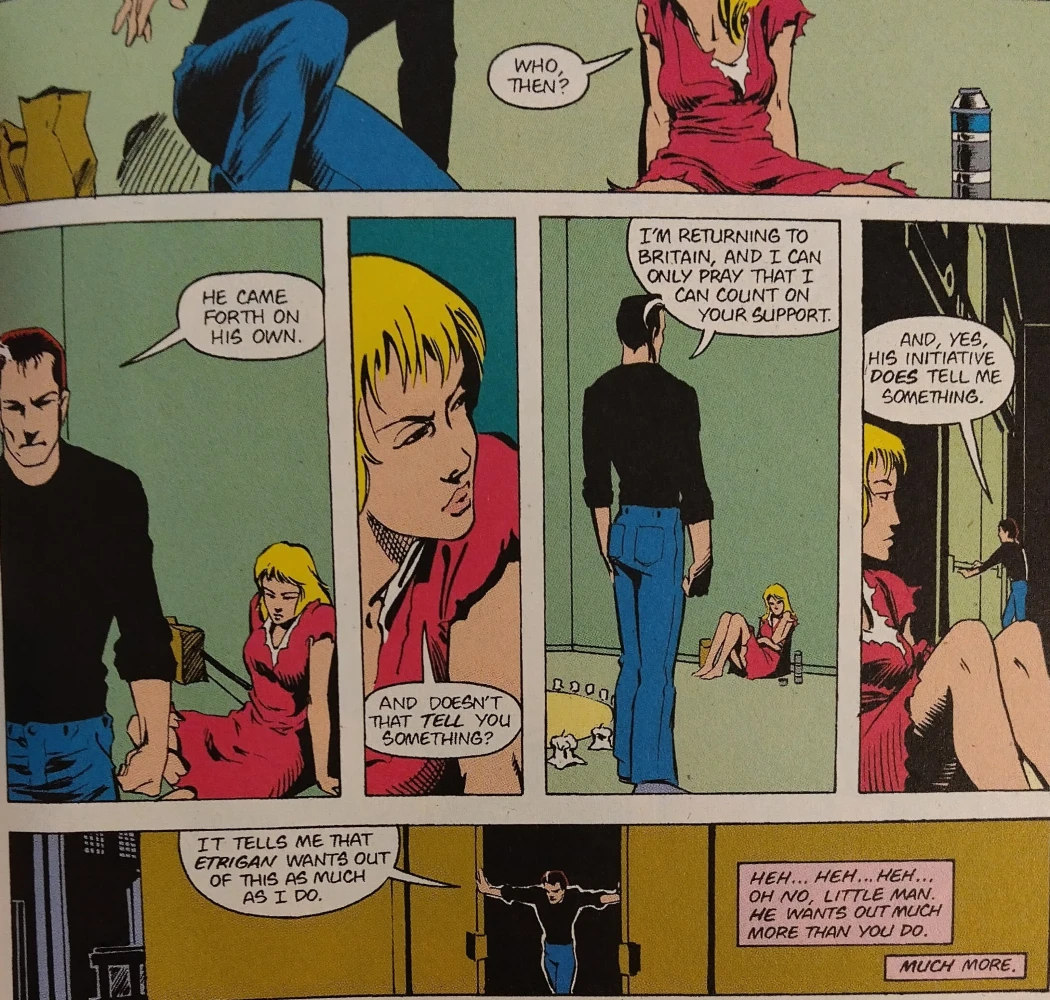
For the sake of spoilers, I won't divulge details, but the series is structured around Wagner deconstructing (demon-structing?) Etrigan in this post-Crisis world in a similar vein to how Moore remolded Swamp Thing, Tim Truman reshaped Hawkman, or Mike Grell refashioned Green Arrow. Like his contemporaries, Wagner reaches into the heart of the character–or hearts, if we're treating Etrigan and Jason separately–and decides to do a bit of twisting on the demon's classic concept. Whereas Kirby, as I understand it, fashioned Etrigan in the guise of an anti-hero, at worst, Wagner follows a decidedly darker path.
Though Wagner crafts Etrigan and Jason as wanting the same ultimate goal–freedom from each other–he presents their single-minded quest in quite disparate ways. Imagine if the Hulk and Bruce Banner both wanted separation yet couldn't collaborate on reaching that goal, Banner's intelligence clashing with the Hulk's brute strength when one or the other maintained control of the "host body." The same conflict occurs here; Etrigan, for all his blather and desire for freedom, is a demon. He's no hero. He's tricky, speaking in roundabout riddles to get what he wants, toying with some of Jason's careful planning, and ignoring some greater causes for his own violent humors. Jason has to rely on this unreliable side of him, placing Glenda in increasingly dangerous situations when his own wits and wisdom must be sidelined for the Demon's supernatural skills.
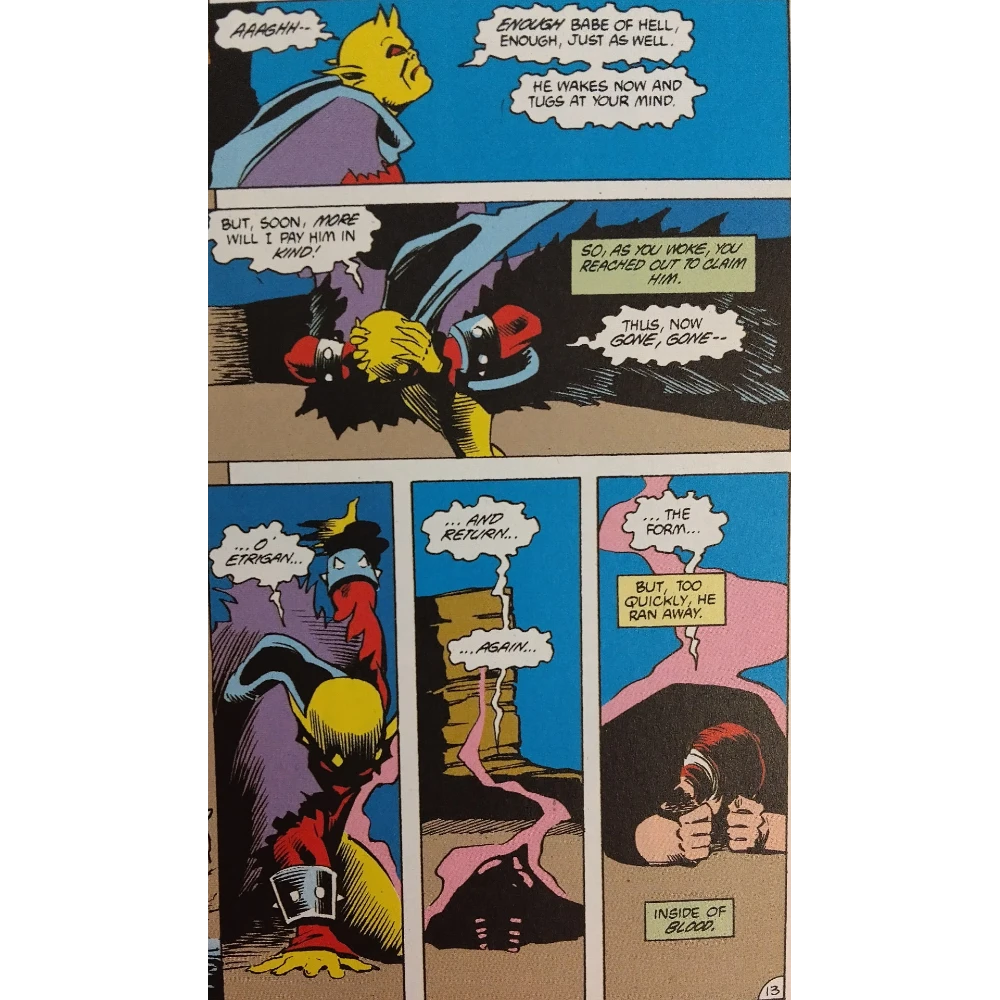
Wagner takes some delight in the irony he's developing, that Etrigan and Jason must work together in order to separate from one another–Jason's cleverness can only get him so far in situations where the Demon's strength is necessary, and Etrigan's tainted perspective is little help in navigating handling collateral damage. In this regard, the characters feel fairly balanced and mandatory for the narrative to continue moving forward. Glenda serves as the lynchpin between both sides, the mouthpiece for one when the other appears, and though her interactions with Jason place her in considerable danger, her staunch defense of this Jekyll-and-Hyde-like being before her is admirable.
I'm not sure how deeply Kirby turned up the seriousness of his series' occult dealings, but Wagner treats the Blood/Etrigan transformations and other pieces of demonic mythology with a decent amount of weight. His strongest issue sees Blood ensnare a demon of some importance within hell's hierarchy, showcasing the bravery necessary to enact such a ritual as well as the heavy consequences when aspects of such a relationship go awry. Wagner isn't attempting any sort of religious critique, but in having characters tangle with demons, he shows the care with which one must commune with spiritual forces and the sheer havoc which can happen when certain lines are crossed, reflecting the chaos spinning out of Jason's life for quite some time.
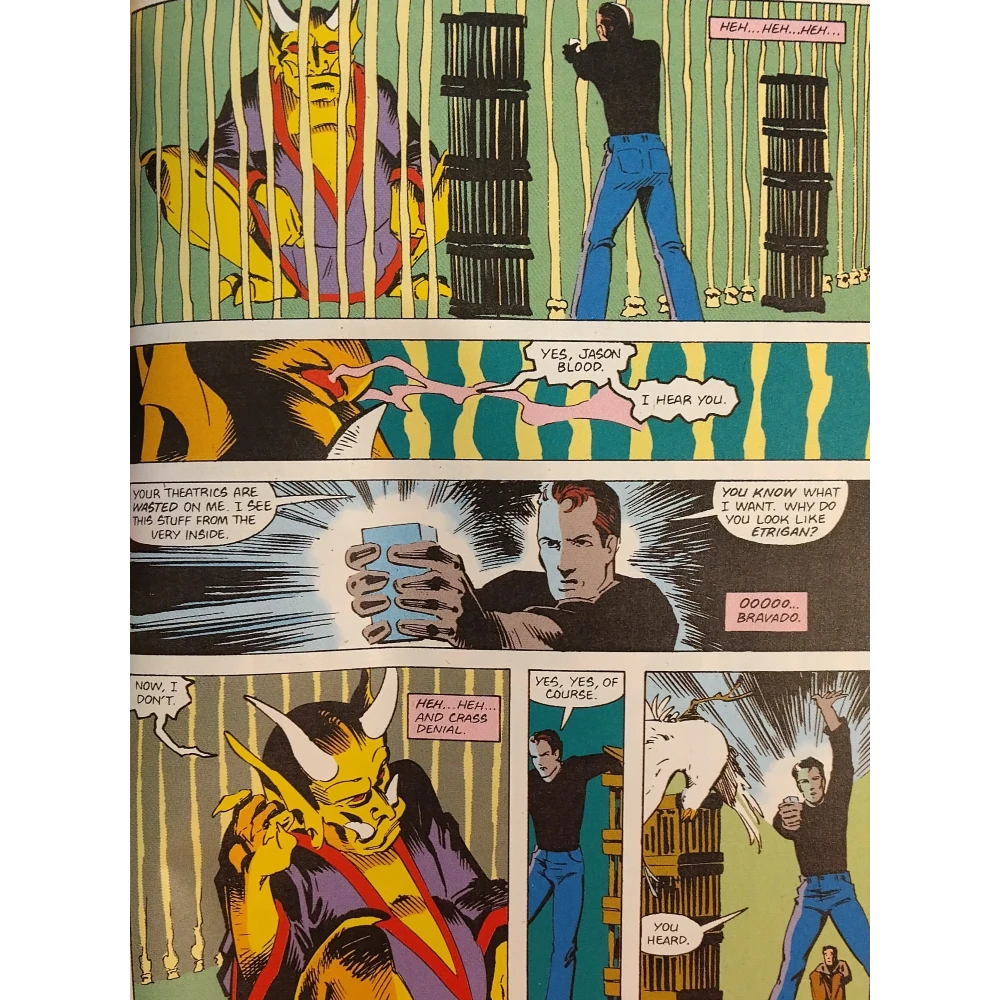
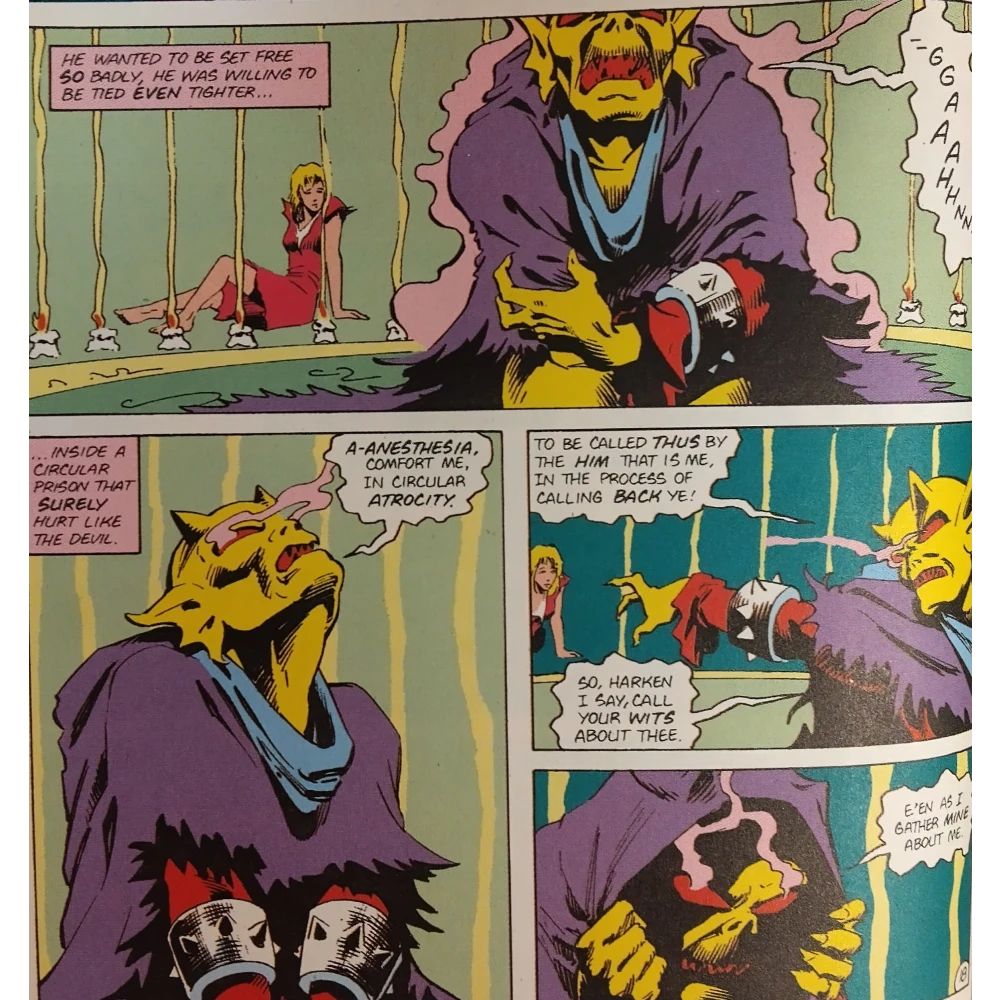
As for words spinning out of our characters' mouths, particularly Etrigan's rhymes, those are a whole other matter. Much of Wagner's story comes complete with caption boxes, an unseen "narrator" guiding us along, which feels hand-holdy. That effect only increases when Etrigan speaks, Wagner utilizing the demon's penchant for poetry to provide additional exposition. Outside of dialogue between Jason and Glenda, you're told a lot, speech working less to offer insight into Jason or Etrigan and more to keep the narrative unfolding.
The consistent exposition may have been better received if Etrigan's delivery were more engaging; Wagner has a few clever lines to throw in, but most of the poetry falls flat, awkward rhymes and line lengths making reading, let along comprehension, a greater exercise than I would have wished it to be. He can't settle on a particular cadence for Etrigan, waffling between different rhyme schemes (including the occasional limerick???), jostling the reader from speech bubble to speech bubble. Consistency and more fluid stanzas would have given Etrigan's rhyming a better lilt, making for an easier, more enjoyable read.
Like other writers in the post-Crisis on Infinite Earths DC Universe, Matt Wagner grabs hold of an established character and decides to tinker with his DNA. He settles on an engaging idea, crafting a greater disparity between Etrigan and his human host and drawing out the darkness within Etrigan's very core (dude is a demon after all). Such a take allows him to play up the inherently grim nature of Etrigan's background, intentions, and actions, casting him in a somewhat more villainous mold which feels necessary here. The writing itself, particularly in Wagner's poetry, can leave quite a bit to be desired, giving us an Etrigan destined to become the next Robert Frost as soon as a certain underworld region experiences frigid winter.
So we've come to the end
Of our little review
Will you read it again?
I sure hope you do…